Native British Pond Plants: A Beginner's Guide to Oxygenators, Marginals and Floaters
A pond that hums with life rarely looks after itself. The clear water, the frogspawn in spring, the damselflies balancing on a leaf — all of it depends on plants doing quiet work at every level of the water. Plant the right layers and the rest tends to follow. Plant the wrong ones, or none at all, and you end up with a green soup that nothing wants to live in.
The three planting zones of a pond
Think of a pond not as one habitat but as three stacked together. Underwater, oxygenators grow entirely submerged and do the job their name suggests. Along the shallow edges, marginals stand with their roots in mud and their leaves in the air. On the surface, floaters and floating-leaved plants shade the water and give insects somewhere to land.
Each group earns its place. Oxygenators compete with algae for dissolved nutrients and give newt larvae, water beetles and dragonfly nymphs cover to hunt from. Marginals shelter froglets, support emerging dragonflies and hide the plastic liner edges. Floaters cut light reaching the water, which slows algae and warms shallow water gently in spring. A balanced pond has all three.
Oxygenators: the underwater workhorses
These are the plants that do the unseen work, and they are also the ones most often bought wrongly. Many bunches sold as "oxygenating plants" are non-native species such as Canadian pondweed, which grows fast, spreads easily and offers less to British wildlife than our own species.
Native oxygenators worth growing
- Hornwort (Ceratophyllum demersum) — rootless, so it simply drifts. Ideal for a new pond, tolerant of shade and easy to thin out by hand.
- Spiked water-milfoil (Myriophyllum spicatum) — feathery, fine-leaved and excellent cover for invertebrates.
- Common water-crowfoot (Ranunculus aquitilis) — white flowers above the surface in summer; happiest in clear, cooler water.
- Water starwort (Callitriche species) — small and tidy, well suited to a modest barrel or half-butt pond.
- Curled pondweed (Potamogeton crispus) — native and useful, but vigorous. Treat it as a plant to watch rather than one to forget.
Plant oxygenators in baskets of plain loam or weighted with a stone, never in rich compost. They feed from the water, not the pot, so fertiliser only encourages the algae you are trying to beat.
Marginals: the fringe that earns its keep
Marginals sit on the shallow shelf, usually in water up to about 20cm deep, and they are the plants you actually look at. Group them in threes or fives rather than dotting single specimens about; clumps look natural and shelter more wildlife.
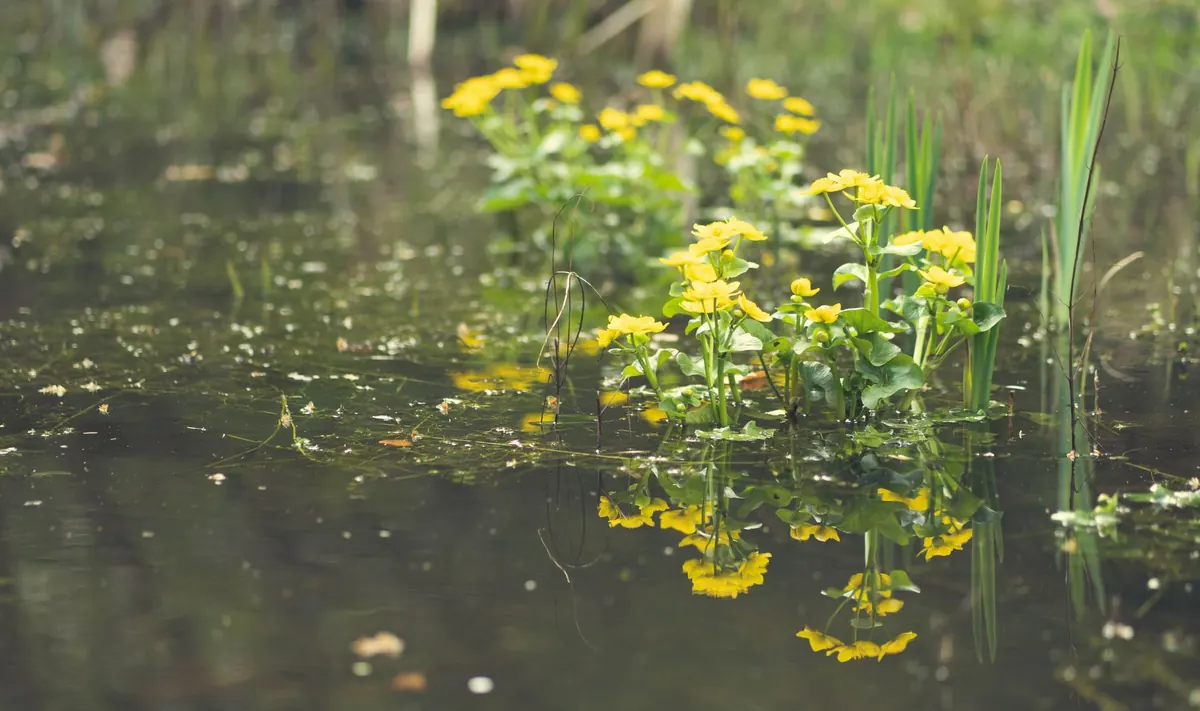
Good native choices include marsh marigold for early yellow flowers, water mint for its scent and its late nectar, water forget-me-not, lesser spearwort, purple loosestrife and flowering rush. Bogbean is a lovely oddity with fringed white flowers, and soft rush gives vertical structure that damselflies love to rest on. Ragged robin and meadowsweet prefer the damp ground just beyond the water, so plant them at the very edge rather than in the water itself.
Yellow flag iris is native, handsome and vigorous. Keep it in a basket or it will colonise the whole shelf within a few seasons. And use loam or ordinary garden soil with no added fertiliser — multipurpose compost leaches nutrients straight into the water and you will spend the summer fighting blanketweed as a result.
Floaters and floating-leaved plants
This is the group that shades the pond, and shade is one of the simplest tools you have against algae. True floaters drift freely on the surface: frogbit with its small lily-like leaves, and water soldier, a spiky rosette that sinks to the bottom for winter and rises again in spring. Both are native and both spread steadily, so start with a small handful.
Floating-leaved plants root in the mud and send their leaves up to the surface. The white water lily and the yellow water lily are our two native species, and both grow far too large for a small pond. In a barrel or a tiny wildlife pond, choose frogbit or amphibious bistort instead.
Avoid the plants that escape. New Zealand pigmyweed, floating pennywort, water fern and parrot's feather are non-native and cause real damage when they reach open water; several are subject to restrictions on sale in the UK. Never move pond plants from one pond to another, and never tip aquarium plants into a watercourse.
Planting a new pond: a simple order of work
- Sort out the levels first. A shelf at roughly 20cm depth for marginals and a deeper middle for oxygenators makes planting straightforward.
- Plant the marginals. Two or three species in generous clumps will beat ten species planted singly.
- Add oxygenators once the water has cleared. They settle better when there is some light reaching below the surface.
- Finish with floaters, but only a little. You can add more; you cannot easily remove duckweed once it has arrived.
- Leave one gently sloping, plant-free edge. Frogs, hedgehogs and birds all need a way in and out.
Fill with rainwater where you can. Tap water carries nutrients and minerals that algae appreciate rather more than your plants do. And if you want amphibians and insects, skip the fish — they eat most of what you are trying to attract.
Keeping the balance year on year
A mature pond needs less fiddling than you might expect. Thin oxygenators in summer if they fill more than about half the water. Skim duckweed and blanketweed with a stick or a rake rather than reaching for a chemical treatment. Cut back marginals in late summer and leave some seedheads standing for the birds and insects that use them over winter.
Do the main tidy-up in late spring rather than autumn, once invertebrates have emerged, and never empty and scrub a pond clean — that removes the whole community you have spent years building. If a plant starts spreading beyond your garden, or you are unsure what you have growing, your local wildlife trust is a good place to ask before you move anything.
Photo: Nicole Menke / Pexels